
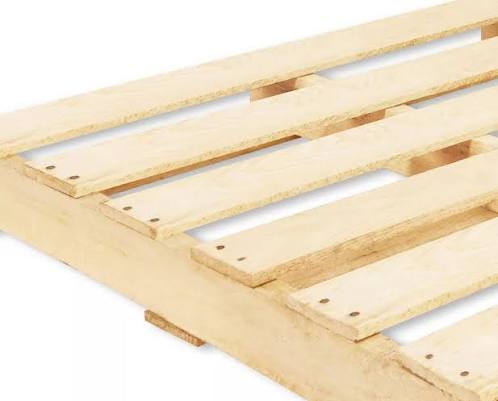
There is no single weight capacity that applies to every pallet. The answer depends on the pallet’s type, material, construction, condition, how the load is distributed, and—critically—how the pallet is supported during use. Asking “how much can a pallet hold?” is a bit like asking “how fast can a car go?” The answer changes based on the car, the road, and the driver.
For warehouse operators, logistics companies, and manufacturers in the UAE, understanding pallet load capacity is not just about avoiding damage. It is a safety issue. Overloaded pallets can collapse, causing injury, product loss, and operational delays. The key is to understand the difference between static, dynamic, and racking loads—and to never assume that a general “safe working load” applies to every situation.
How Much Weight Can a Standard Pallet Hold?
Capacities vary widely between wooden, plastic, metal, and specialty pallets. A verified reference point is the EPAL Euro pallet, which has a published safe working load of 1,500 kg under the manufacturer’s specified conditions. This is a commonly cited benchmark.
However, this figure should not automatically be applied to every 1,200 × 800 mm wooden pallet. A generic wooden pallet of the same dimensions may have a different capacity depending on its wood species, board thickness, block configuration, and fastener quality. Without manufacturer documentation, assigning a specific capacity to a generic pallet is guesswork.
Static vs Dynamic vs Racking Load Capacity
The same pallet may have different safe capacities depending on how it is used. These three categories are the foundation of any load calculation.
Static load refers to the weight supported when the pallet is stationary on a suitable, even surface. This is typically the highest capacity figure because the load is evenly distributed and there is no additional stress from movement.
Dynamic load refers to the weight supported while the pallet is being moved by a forklift, pallet jack, or other handling equipment. Dynamic capacity is lower than static capacity because movement introduces forces—vibration, acceleration, deceleration—that stress the pallet’s structure.
Racking load refers to the weight supported when the pallet is stored on warehouse racking. This is often the most restrictive condition. When a pallet is placed on rack beams, it is supported only at two points (or across a span), rather than across its entire base. This concentrates stress on specific areas of the pallet.
A pallet rated for 1,500 kg static may have a much lower racking capacity. The safe working load published by the manufacturer should not automatically be treated as the approved racking capacity.
What Determines How Much Weight a Pallet Can Hold?
Multiple factors interact to determine actual load capacity:
- Pallet material: Wood, plastic, and metal have different strength characteristics.
- Pallet dimensions: Length, width, and height all influence structural behavior.
- Wood species and quality: Hardwood pallets generally outperform softwood, but quality varies.
- Board thickness: Thicker deck boards resist bending and flexing better.
- Stringer or block construction: The support structure underneath the deck determines how loads transfer to the ground or rack.
- Number and position of support points: More support points distribute stress more evenly.
- Nail or fastener quality: Poor fasteners can fail under load, causing structural collapse.
- Pallet condition: New, used, and repaired pallets have different capacities.
- Load distribution: Even distribution maximizes capacity; concentrated loads reduce it.
- Warehouse storage type: Floor storage, stacking, and racking each create different stress patterns.
- Handling equipment: Forklift tines, pallet jacks, and other equipment interact differently with the pallet structure.
Does Pallet Size Affect Load Capacity?
Dimensions and construction influence capacity, but a larger pallet is not automatically stronger. A larger pallet may span more distance between support points, which can increase bending stress. Conversely, a smaller pallet may concentrate load more effectively.
Different pallet formats have different published capacities. EPAL, for example, lists different safe working loads for its various formats:
- EPAL Euro pallet (1,200 × 800 mm): 1,500 kg safe working load
- EPAL 3 (1,000 × 1,200 mm): 1,500 kg safe working load
- EPAL 7 half pallet (800 × 600 mm): 500 kg safe working load
These variations illustrate why pallet size alone does not determine capacity.
How Much Weight Can a Wooden Pallet Hold?
Wooden pallets are the most common type in UAE warehousing and logistics. Their capacity varies significantly across categories.
New wooden pallets have maximum structural integrity and typically carry the highest rated loads for their design. A new EPAL Euro pallet, for example, is rated for 1,500 kg.
Used wooden pallets may have reduced capacity due to wear, minor damage, or fatigue in the wood fibers. A used pallet that looks intact may still have internal weaknesses.
Repaired pallets vary widely. A professionally repaired and inspected pallet may retain most of its original capacity, while a field-repaired pallet with mismatched components may be significantly weaker.
Heavy-duty pallets are designed with thicker boards, stronger blocks, and sometimes additional reinforcement to carry loads beyond standard ratings.
Custom pallets may have capacities engineered for specific applications, but these ratings apply only when used as designed.
A generic wooden pallet should not be assigned a specific capacity without knowing its construction and specifications. If capacity matters for safety or product protection, obtain documented ratings from the manufacturer.
How Does Load Distribution Affect Pallet Capacity?
Weight should be distributed evenly across the pallet deck. Even distribution allows the pallet’s structure to share the load across all boards and blocks.
Concentrated loads—heavy items placed on a small area—create localized stress that can exceed the pallet’s design limits even when the total weight is below the rated capacity.
Uneven loading shifts the center of gravity, increasing stress on one side or one corner. This can cause the pallet to tilt or collapse under dynamic conditions.
Overhanging goods extend beyond the pallet’s edge, placing leverage on the deck boards and reducing effective capacity.
Loads extending beyond the pallet create similar issues and may interfere with racking or handling equipment.
Proper wrapping and stabilization help maintain load integrity during movement. Unstable loads can shift, creating dynamic forces that exceed the pallet’s rating.
An unevenly distributed load can create additional stress even when the total weight is below the pallet’s stated capacity. Capacity ratings typically assume uniformly distributed loads.
How Much Weight Can a Pallet Hold in a Warehouse Rack?
Racking conditions require special attention because the support pattern is fundamentally different from floor storage. On the floor, the pallet is supported across its entire base. In a rack, it rests on beams that may contact only a portion of the pallet’s underside.
Beam spacing determines how much of the pallet is unsupported. Wider spacing increases bending stress on the deck.
Pallet support depends on the rack design and how the pallet sits on the beams. Some racks provide full support across the pallet width; others contact only the pallet’s edges.
Rack design varies widely. Selective racking, drive-in racking, push-back racking, and other systems create different load conditions.
Pallet orientation matters. A pallet placed across its width may behave differently than one placed lengthwise.
Load distribution interacts with rack support. A well-distributed load on a properly supported pallet performs better than a concentrated load on the same setup.
Pallet condition is critical in racking. A pallet with weakened boards or blocks may fail under racking loads even if it performs adequately on the floor.
A pallet’s general safe working load should not automatically be treated as its approved racking capacity. Racking capacity must be determined based on the specific rack system and pallet design.
Can a Used Pallet Hold the Same Weight as a New Pallet?
Condition matters. A used pallet may have reduced capacity due to:
- Broken boards: Missing or cracked deck boards reduce load distribution.
- Missing boards: Gaps in the deck create concentrated stress points.
- Split blocks or stringers: Structural components that fail compromise the entire pallet.
- Loose nails: Fasteners that have pulled loose allow boards to shift under load.
- Severe warping: Deformed pallets do not sit properly on supports or rack beams.
- Water damage: Moisture weakens wood fibers and promotes rot.
- Rot: Decayed wood loses structural integrity.
- Chemical contamination: Some chemicals degrade wood or create safety hazards.
- Previous repairs: Quality and suitability of repairs vary widely.
Damaged pallets should be removed from service or professionally assessed and repaired where appropriate. Continuing to use a compromised pallet risks sudden failure under load.
How to Check a Pallet’s Weight Capacity
Use this practical checklist:
- Identify the pallet type. Is it wood, plastic, or metal? Is it a standard design or custom?
- Check manufacturer specifications. Look for documented safe working load ratings for static, dynamic, and racking conditions.
- Inspect the pallet’s physical condition. Look for damage, wear, and signs of weakness.
- Determine whether the load is static, dynamic, or racked. Each condition has different capacity limits.
- Check how the load will be distributed. Will it be even, concentrated, or overhanging?
- Confirm the handling equipment and storage system are suitable. Forklift tines, rack beams, and other interfaces affect performance.
- Never exceed the manufacturer’s stated limits. If no rating is available, err on the side of caution.
How to Avoid Overloading a Pallet
Practical steps to prevent overload failures:
- Weigh goods before loading. Know the actual weight, not an estimate.
- Distribute weight evenly. Center the load and keep it balanced.
- Keep heavy items stable. Secure loads to prevent shifting.
- Avoid excessive overhang. Keep goods within the pallet footprint.
- Use the correct pallet size. Match the pallet to the load and storage system.
- Inspect pallets before use. Remove damaged pallets from service.
- Follow warehouse and racking requirements. Rack capacity may be lower than pallet capacity.
- Replace damaged pallets. Do not attempt to extend the life of a compromised pallet.
For UAE warehouse operators and logistics companies, the safest approach is to treat pallet load capacity as a specification—not a guess. Use documented ratings, inspect pallets regularly, and match the pallet to the specific application. When in doubt, reduce the load rather than risk a failure.

1 Comment
nas woodenpallets
A pallet’s weight capacity depends on its material, design, and overall condition. Choosing the right pallet is important for safe storage and transportation, especially when handling heavy loads. For wooden pallets and related solutions, you can also visit https://www.nas-woodenpallets.com/ to learn more.